
Health & Care · Cold-Blooded Crew
The Tropical Rainforest Vivarium
High-Humidity Setup for Dart Frogs, Tree Frogs, and Crested Geckos
A screen cage dries a tree frog out; a sealed aquarium rots it. 20 modules on the living jungle, front-opening glass with partly sealed tops, the hydroball basement and mesh barrier, the ABG soil mix, springtails and isopods, bromeliads, vines, and ferns, water features under an inch deep, high-pressure rain on a timer, drying between mistings, Ferguson Zone 1 UVB, a hard 80°F ceiling, anchoring manzanita and cork, dart frog colonies, nocturnal geckos and tree frogs, fruit flies and dusting, the Vitamin A rule, conditioned water and nitrile gloves, daily skin audits, and the amphibian vet.
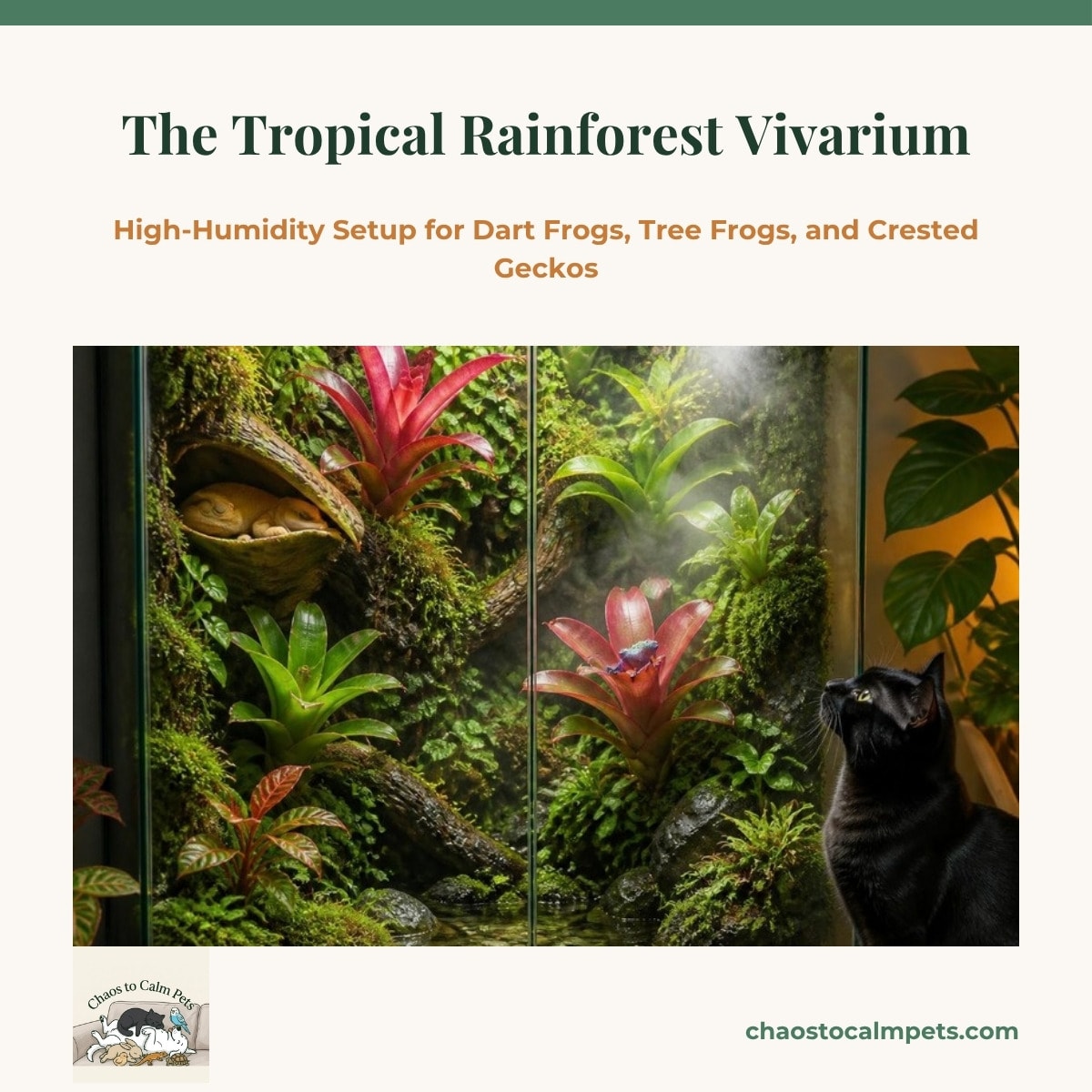
About this course
Humidity is the whole game for frogs and crested geckos, and the two cheap ways to get it wrong are a screen cage that can't hold it and a sealed tank that turns it into mold. This course builds the third way. You'll learn why a front-opening glass terrarium with a partly covered top is the standard, how the two-to-three-inch hydroball layer, the mesh barrier, and the access pipe keep water where it belongs, what goes in the ABG mix and why charcoal keeps soil sweet, how springtails and dwarf isopods become the cleaning staff before the animals arrive, which bromeliads, vines, orchids, ferns, and mosses live at each height, why a water feature deeper than an inch or with steep walls drowns a clumsy frog and how to build one that doesn't, how a high-pressure mister on a timer delivers short bursts two or three times a day, why surfaces should dry between storms, what a Ferguson Zone 1 UVB tube looks like and why dappled is the goal, why 80°F is a hard ceiling for animals that cannot sweat, how to anchor manzanita, ghostwood, and cork and build sleeping perches, how dart frog colonies are housed and when wrestlers get separated, why nocturnal geckos and tree frogs are never woken by day, how to culture fruit flies and shake-and-bake them in calcium and vitamins, why weekly Vitamin A prevents short-tongue syndrome, why only conditioned RO water and wet nitrile gloves ever touch an amphibian, what the daily skin and body-condition audit catches, and how to find an ARAV amphibian vet.
What you'll learn
- The living jungle: front-opening glass, partial top seals, and waterproof integrity
- Drainage, geotextile barrier, ABG soil, and seeding the clean-up crew first
- Bromeliads, vines, and understory plants; safe shallow water features
- Rain on a timer, drying between mistings, Zone 1 UVB, and the 80°F ceiling
- Branches and perches, dart frog colonies, and nocturnal gecko and tree frog care
- Fruit flies, dusting, Vitamin A, conditioned water, gloves, daily audits, and the vet
Who this is for
Keepers setting up crested geckos, tree frogs, or dart frogs for the first time, and anyone whose humid tank keeps growing mold instead of frogs.
Course outline (20 modules)
Quiz & Certificate
Knowledge quiz
After completing all lessons, take a short quiz to test your understanding.
Go to quiz →Completion certificate
Pass the quiz and earn a shareable certificate of completion.
View certificate →Frequently asked questions
Ready to get started?
$9.99 · Lifetime access · 20 lessons