
Meet Paola
From Under-the-Bed Bugs to a Multi-Species Pack
A lifetime of animals, hard lessons, and the unorthodox methods that actually work.
Hi, I'm Paola.
I was born in Washington DC to a French family, spending my early childhood bouncing between DC, Montreal, and Quebec before settling back in the DC area in 1994.
From the time I could walk, I was obsessed with animals. I was the kid keeping bugs in critter keepers hidden under my bed. By the time I was eight, I had my first budgies. By ten, under the tutelage of a school library book, I was confidently (and probably terribly) clipping their wings. My grandmother in France taught me how to feed wild baby birds, and my first "trained" budgie, Rainbow, went absolutely everywhere with me. She rode in my backpack to school, attended my karate classes, went to work with me, and slept on a paper towel right next to my pillow.
Then, one day, she fell out of my backpack, and I lost her.
This was the late 90s. Google didn't exist. Forums didn't exist. My early budgies lived on all-seed diets and rarely made it past 5 or 6 years old.
The Hard Lessons
I have a story for almost every animal situation imaginable, and many of them I'm not proud of. I want to be entirely transparent: I did not start out doing things the "right" or the safe way.
Because of ignorance and a sheer lack of accessible information, I made mistakes. Heartbreaking ones. I lost pet birds because I didn't use proper travel containers. I lost reptiles because I didn't understand the vital importance of strict humidity levels and proper UVB lighting. When people brought me wild, hurt animals to rehabilitate — fawns, baby raccoons, opossums, newborn field mice, and nearly every songbird Northern Virginia has to offer — I would sometimes "introduce" them to my pets so my dogs would know not to hunt them.
Today, we know the immense zoonotic disease risks wild animals carry. We know the sheer terror that interaction causes a wild prey animal. I would never recommend or approve of the things I did back then. But I am sharing this because my respect for safety protocols today was forged in the fire of those early mistakes.
Building the Pack (and the Exceptions)
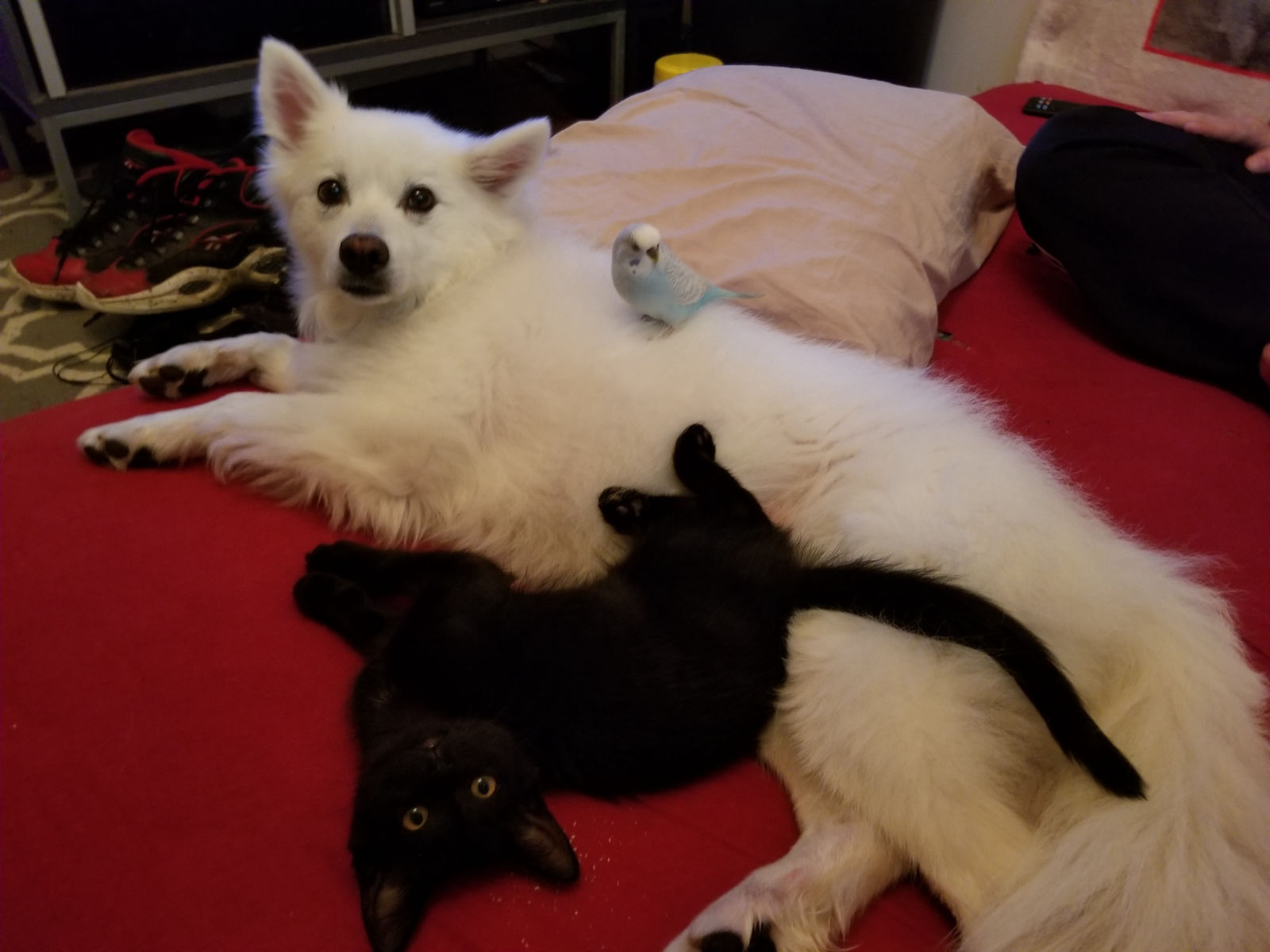
When I was 19, I got my brother Thomas an American Eskimo named Noel. I trained Noel, alongside my parents' cat, Cleo, to co-exist with my budgies. From that point on, I became the unofficial multi-species trainer for my friends, family, and even a stray cat named Aya at an ayahuasca retreat!
Over the years, I've successfully integrated dogs and cats with budgies, mice, geckos, guinea pigs, and tortoises. My philosophy was born from experience: I believe that when a dog or cat truly realizes a small animal is part of their family group — their pack — the desire to hunt them diminishes.
But I also learned the hard way that a pack dynamic is never a 100% guarantee.
My dog Noel had virtually zero prey drive his entire life. He would happily let my budgies climb right into his food dish to eat alongside him. But in his last few years, a genetic cognitive disease changed his brain. One day, he nearly killed one of my budgies for getting close to his food — something she had safely done for years.
Pain, disease, hunger, aging, and environmental stress can change an animal's behavior in an instant. Even the best-trained pet can one day do something completely abnormal. It is our job to keep them safe.
The Pack Today
If you look at the photos on this website, you are looking at my daily life. My current pack consists of a black Halloween cat named Shadow, a standard American Eskimo named Ghost, a toy American Eskimo named Angel, and a 4-month-old indoor silkie chicken named HeyHey. Angel and HeyHey are absolute best friends; they eat together, sleep together, and free-roam the house.
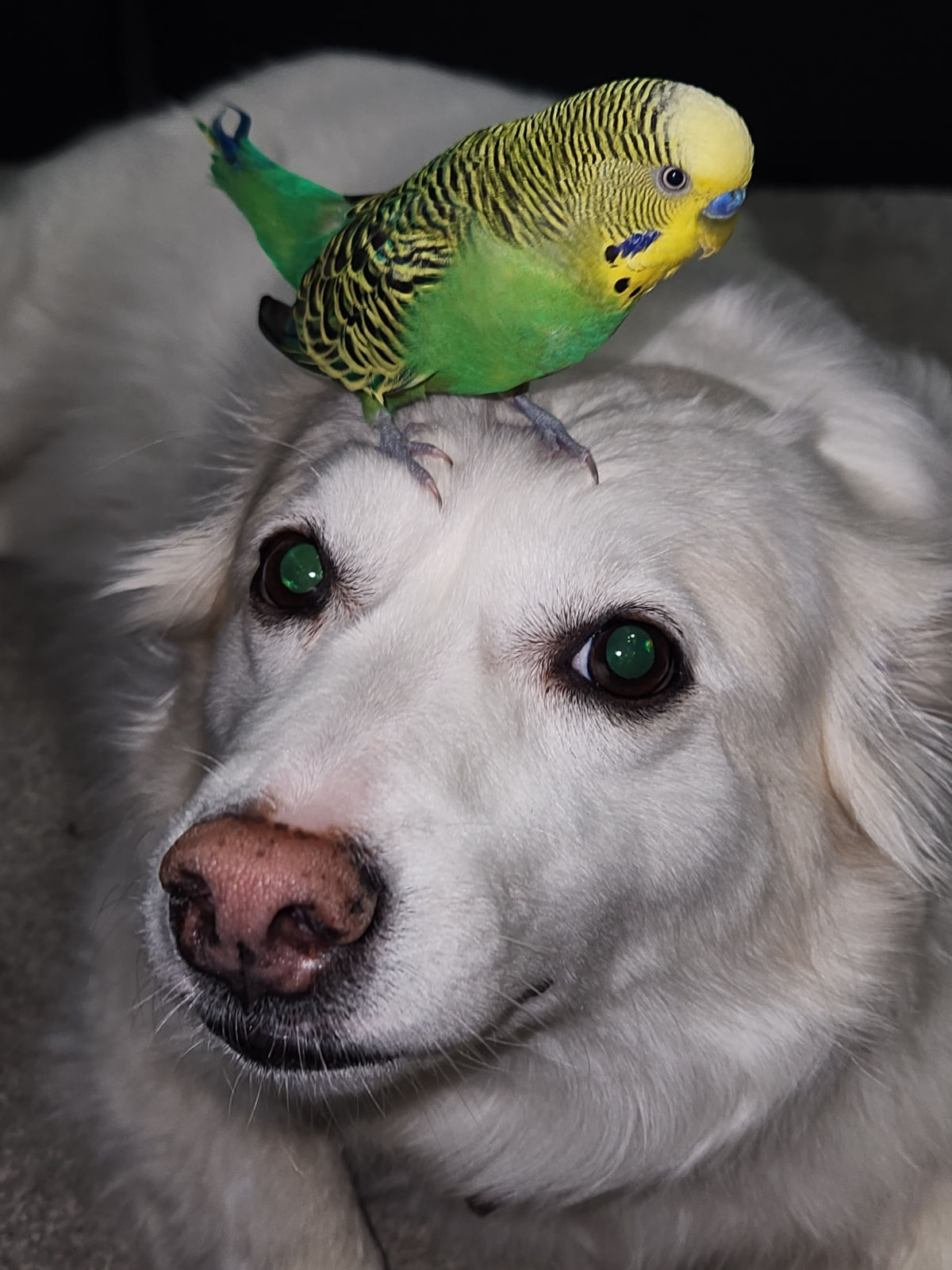
And then there is Neige. She is my 11-year-old budgie — the oldest, most fearless member of the pack. The birds' cage remains unlocked, but they usually only choose to come out when I am home. Because HeyHey the chicken is currently in her chaotic "teenage" phase, we have to supervise her closely around the budgies to ensure her beak doesn't accidentally hurt them. But Neige frequently goes on outdoor outings with us.
Why I Offer In-Home Assessments
I built the Chaos to Calm Pets Digital Academy using the most rigorous, up-to-date, scientifically-backed veterinary information available, specifically so you don't have to make the tragic mistakes I did.
However, I also know that science sometimes tells us things are impossible, when real-world experience shows us they can be done. That is why I offer 1-on-1 In-Home Assessments and Training.
My personal integration methods are highly unorthodox. They aren't covered in the digital courses because they require nuanced, hands-on application and a deep understanding of animal body language.
The Shared Outing Bond
Taking pets on shared car rides or trips to quiet creeks removes them from their territorial comfort zones. Facing a new, slightly scary environment together is one of the fastest ways for different species to bond with each other and with you.
Proximity During Rest
I routinely move small pet enclosures much closer to dogs and cats only when the predators are tired, well-fed, and deeply calm. This helps the prey animal realize the predator isn't a threat, reducing their panic response.
Two-Way Training
A dog's prey drive is triggered by panic. If a budgie flutters and screams, the dog will chase. In my home, I train the prey animal to be calm just as much as I train the predator. I have held my budgie, Neige, right up to dogs so they can smell her without leashing the dog (to avoid leash reactivity). I can leave Neige alone with most of my friends' dogs now, only because Neige doesn't act like prey.
I strongly advise that you do not try these methods on your own. They require years of experience reading micro-stress signals to prevent a tragedy.
If you want to get your small exotic pets out of their cages so they can live enriched, fascinating lives alongside your cats and dogs, I can help. I will come to your home, assess your specific animals' personalities, and use my decades of (sometimes messy, always educational) experience to show you what is realistically possible and exactly how to do it safely.
Having a pack with feathers, fur, and scales is a beautiful, chaotic, joy-filled experience. Let me help you build yours safely.
What I bring to the table
Science-first approach
Every technique in my courses is built on what actually works — positive reinforcement, patience, and a genuine understanding of how each animal thinks. No dominance theory, no punishment-based methods.
Real multi-species experience
I've lived with dogs, cats, birds, reptiles, and small mammals simultaneously. I know what works in theory and what actually holds up at 7am when everyone wants breakfast at the same time.
Honest about limitations
I'll never promise you a guaranteed outcome. Animals are individuals. What I can promise is the best possible framework — and complete transparency about where science ends and personal experience begins.
Continuously learning
Behavioral science evolves. I update course content when new research changes best practices, and I'm always studying, attending seminars, and consulting with veterinary behaviorists.
Official Credentials
Certified Dog Trainer
Paola holds professional certifications from two recognized dog training organizations.

GDA PDT Certified
Graduate Dog Academy

CAPDT Certified Member
Canadian Association of Professional Dog Trainers
Why this matters
Millions of animals are surrendered every year because their owners couldn't manage multi-pet dynamics. Most of those situations were preventable with the right knowledge at the right time. That's what Chaos to Calm Pets is here to change — one household at a time.
Ready to build your pack?
Book an in-home assessment and let's figure out what's possible for your specific animals.
Book an Assessment