
Training & Behavior · Cold-Blooded Crew
Socializing Intelligent Lizards
Building Trust and Voluntary Handling
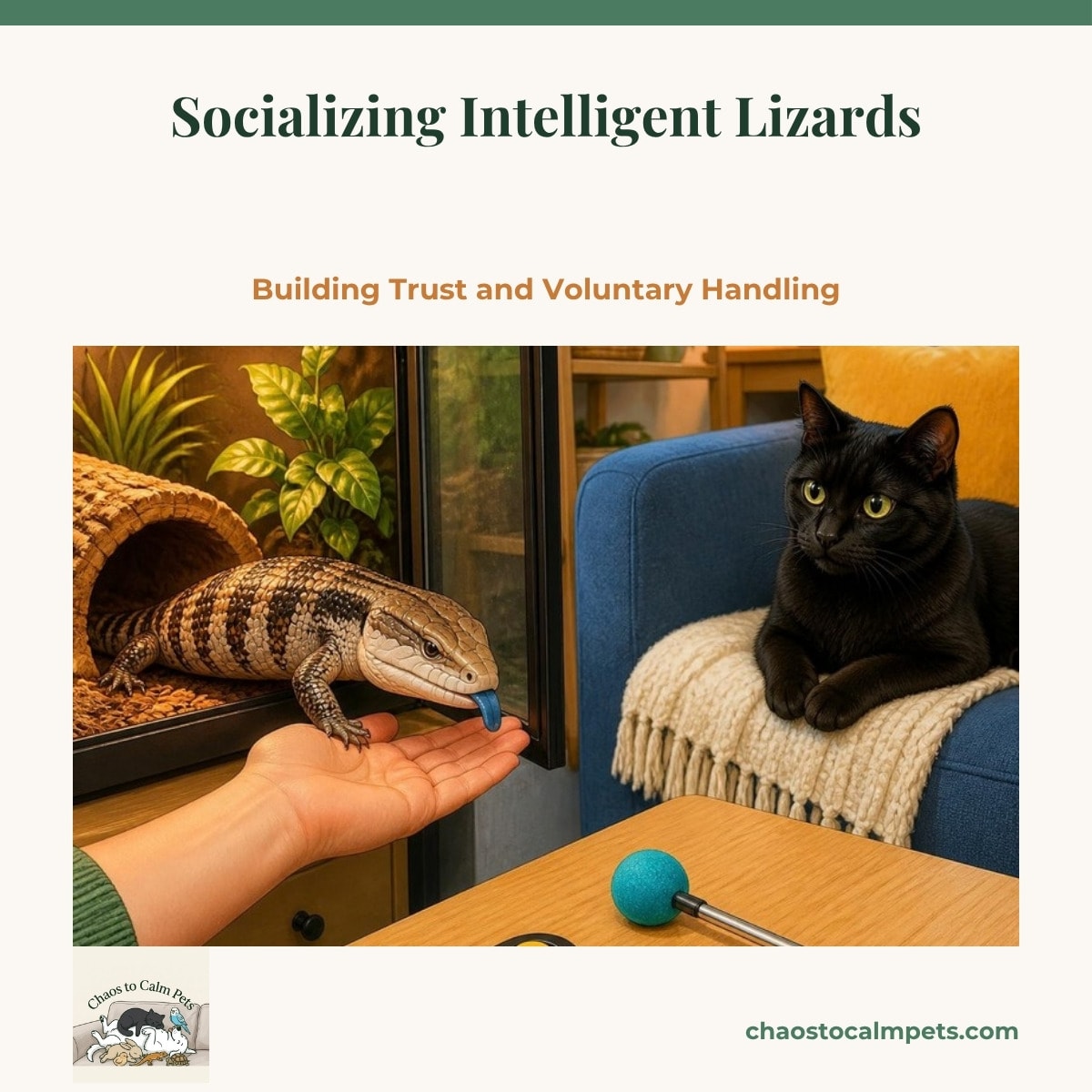
Monitors, tegus, dragons, and skinks can learn; most of them have just never been taught. 20 modules on how lizard brains learn, habituation versus domestication, body language, the enclosure as sovereign territory, side approaches, loading a clicker, target training, the opt-in and opt-out, supporting all four limbs, free-roam proofing, puzzle feeders, harness training, rehabbing biters with touch desensitization, cooperative vet care, monitors and the worn t-shirt trick, dragons and skinks, hygiene, handling burnout, and when aggression is pain.
About this course
A monitor that walks onto a scale on cue and a bearded dragon that comes to the door when it sees you are not tricks; they're what happens when you stop grabbing and start teaching. This course is Calm Consent for lizards. You'll learn what modern science says about reptile spatial memory and associative learning, why a calm lizard is habituated rather than domesticated and why that distinction keeps you safe, how to read a flattened body, a gape, a dark beard, and the signs of real comfort, why the enclosure is never a place for ambush grabs and why sessions happen on neutral ground, how an overhead hand reads as a hawk and a side approach doesn't, how to load a clicker and mark the exact moment a nose touches a target, how to build an opt-in signal and honor every opt-out, how to carry a heavy lizard with every limb supported and never by the tail, how to proof a room and cap free-roam at twenty to thirty minutes so body temperature doesn't crash, how puzzle feeders and cardboard boxes make you the interesting part of the day, how to harness-train indoors before the first outdoor sun, how to rehabilitate a biter with touch desensitization and why pulling your hand away rewards the lunge, how to train scale and exam positions for the vet, why a monitor needs a predictable routine and your worn t-shirt, how dragons and skinks respond to daily food-paired handling, how to keep hands and surfaces clean, how to spot handling burnout and give a multi-week rest, and when sudden aggression means pain and a vet.
What you'll learn
- How lizard brains learn, habituation versus domestication, and reading body language
- Enclosure sovereignty, neutral territory, side approaches, and passive desensitization
- Clicker loading, target training, the opt-in and opt-out, and safe holds
- Free-roam proofing and thermal limits, puzzle feeders, and harness training
- Rehabbing biters, cooperative vet behaviors, monitors, dragons, and skinks
- Hygiene, handling burnout, and ruling out pain behind sudden aggression
Who this is for
Keepers of monitors, tegus, bearded dragons, blue-tongued skinks, and uromastyx who want a partner instead of a hostage, and anyone with a lizard that currently bites.
Course outline (20 modules)
Quiz & Certificate
Knowledge quiz
After completing all lessons, take a short quiz to test your understanding.
Go to quiz →Completion certificate
Pass the quiz and earn a shareable certificate of completion.
View certificate →Frequently asked questions
Ready to get started?
$9.99 · Lifetime access · 20 lessons