
New to Your Home · Birds
Baby Budgies and Cockatiels
Navigating the Fast-Track 4-Week Fledging Window
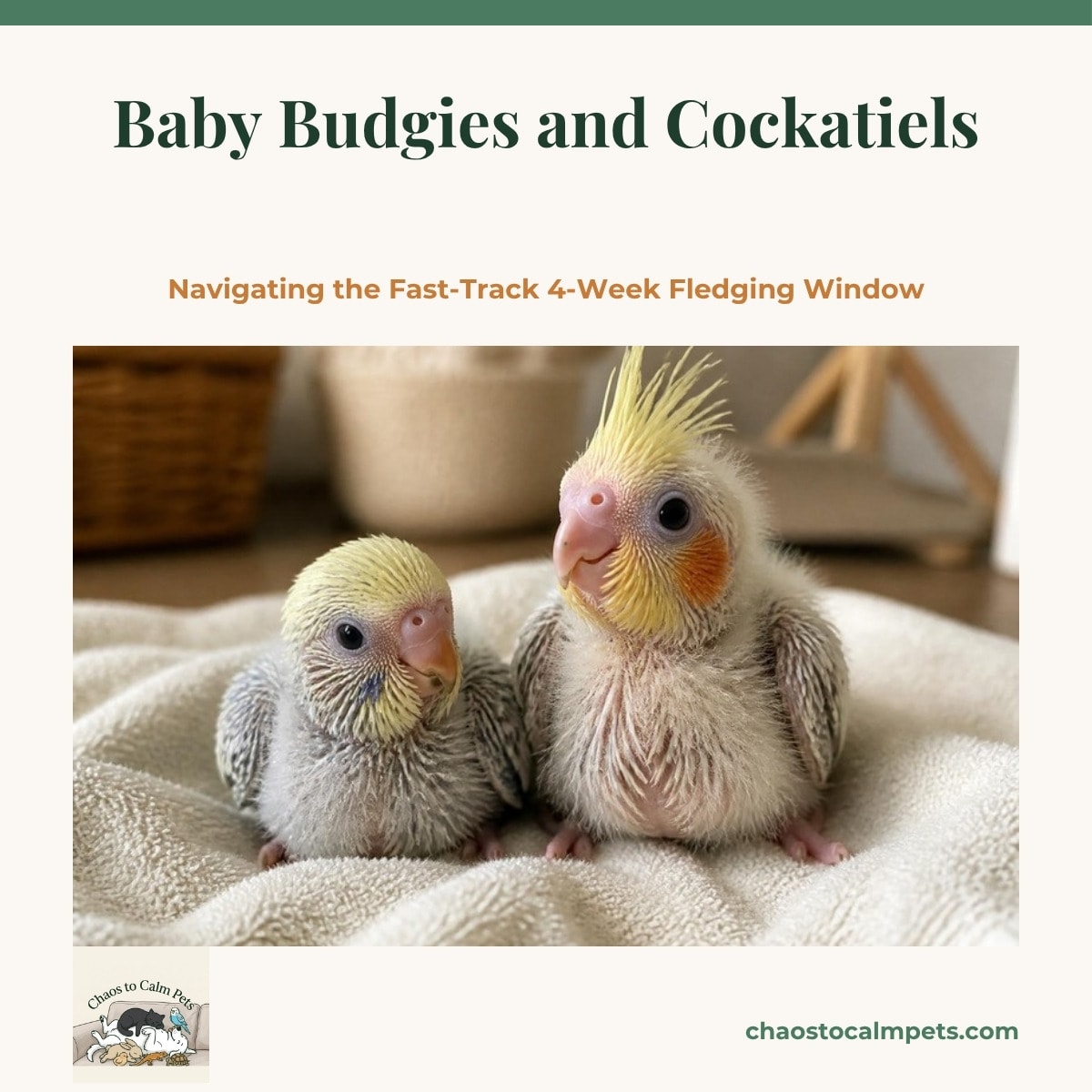
A budgie or cockatiel goes from blind hatchling to flying juvenile in 4 to 6 weeks, which leaves no room for a missed feeding. 10 lessons on why these Australian birds grow so fast, 1 mL syringes and the 10 percent rule for tiny crops, candling paper-thin eggs with a cool LED, the itchy porcupine phase, spray millet as a weaning magnet, the week 5 to 6 weaning timeline, crash-proofing for ping-pong fledglings, sexing by cere and tail barring, why singletons need company, and the first molt and bluffing phase.
About this course
Budgies and cockatiels evolved in the dry middle of Australia, where breeding happens fast or not at all, and their babies grow on that same clock. Lesson 1 explains why a newborn doubles its weight every couple of days and why a single missed feeding matters more here than with a macaw. You'll feed micro-volumes with a 1 mL syringe and the 10 percent rule, which for a 5 gram cockatiel chick means half a milliliter at most. Lesson 3 covers candling eggs that weigh 2 to 5 grams without cooking or cracking them, and Lesson 4 the itchy porcupine phase when pin feathers come in and a warm mist helps. Then it's weaning: spray millet as the food that unlocks everything, solid food starting around day 21 to 25, the mid-day feed dropped near day 30, and independence by week 5 or 6. Lesson 7 is the ping-pong fledgling bouncing around your padded room, and Lesson 8 shows how to read a budgie's cere and a cockatiel's tail barring. The course ends with why these birds should never be raised alone, and what to expect from the first molt and the bluffing that comes with it.
What you'll learn
- Why budgies and cockatiels reach independence in 4 to 6 weeks, and what that demands
- Micro-volume feeding with 1 mL syringes, the 10 percent rule, and candling paper-thin eggs
- Easing the porcupine pin-feather phase and using spray millet as the weaning magnet
- The day 21 to week 6 weaning schedule, and padding a room for ping-pong fledglings
- Sexing by cere color and tail barring, with DNA testing when it has to be certain
- Pair and group rearing against species dysphoria, then the first molt and bluffing
Who this is for
Budgie and cockatiel breeders hand-feeding their first fast-track clutch; owners who ended up with an abandoned chick and a kitchen scale; and anyone whose sweet hand-fed baby just turned four months old and started hissing at them.
Course outline (10 modules)
Quiz & Certificate
Knowledge quiz
After completing all lessons, take a short quiz to test your understanding.
Go to quiz →Completion certificate
Pass the quiz and earn a shareable certificate of completion.
View certificate →Frequently asked questions
Ready to get started?
$9.99 · Lifetime access · 10 lessons