
New to Your Home · Birds
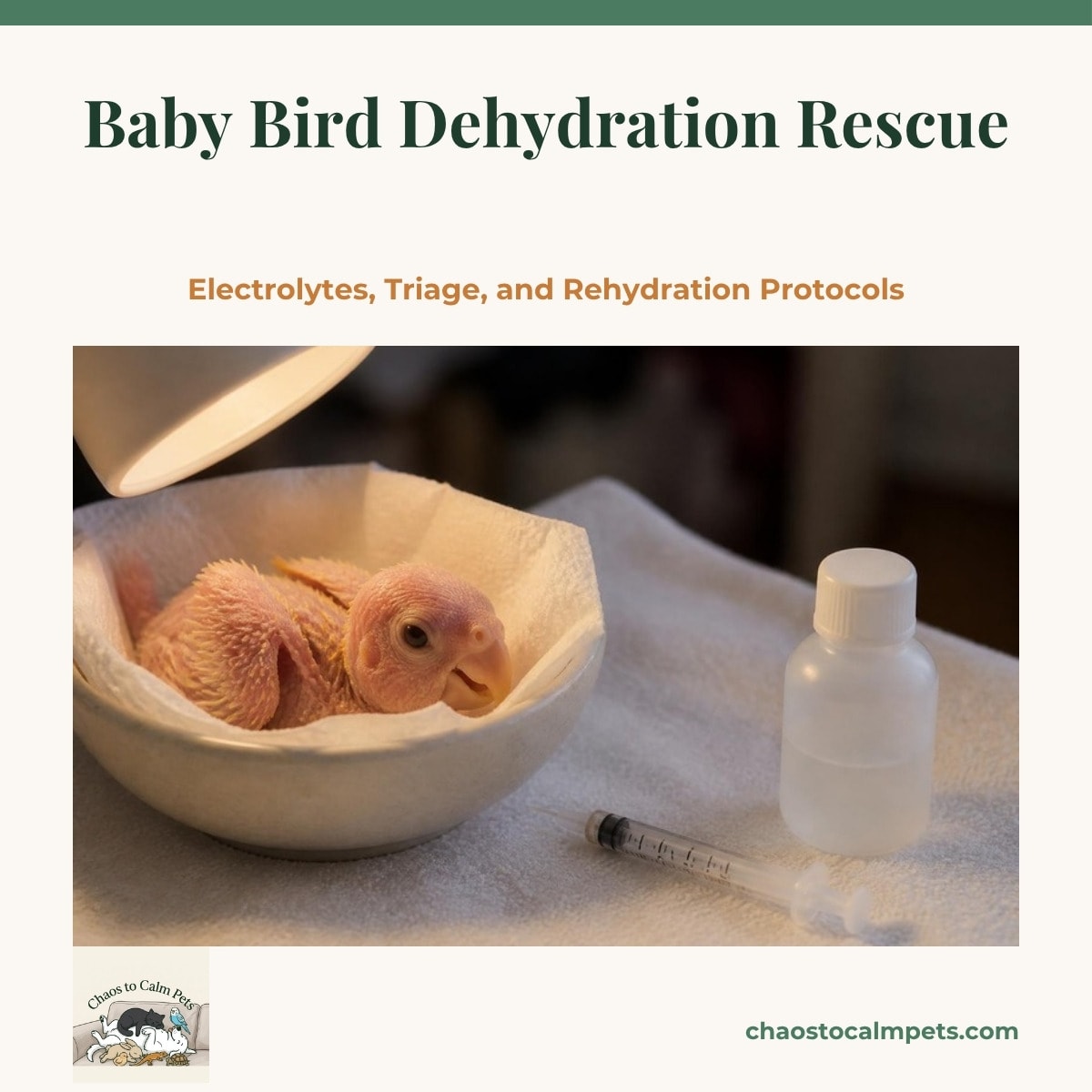
Baby Bird Dehydration Rescue
Electrolytes, Triage, and Rehydration Protocols
A dehydrated chick crashes faster than almost any other baby animal, and the first hour decides it. 10 lessons on the wrinkled skin, sunken eyes and dark vessels that mean act now, the cold red skin of a chick going into shock, why plain water can kill and what to give instead, what subcutaneous fluids are and why they stay in the vet's hands, why formula never goes into a dehydrated crop, flushing a crop packed with old food, warming the chick before any fluids, hourly micro-doses, the white urates that prove the kidneys are back, and stepping back to normal food.
About this course
A naked chick has permeable skin and little fluid reserve, so a skipped feeding or a dry brooder can tip it into shock in hours. This course is the sequence you follow when that happens, and when to hand it to your avian vet. You'll learn the three signs of acute dehydration, wrinkled skin that won't snap back, sunken eyes and dark sluggish vessels, and the cold, fiery red skin that means circulation is collapsing and home care is no longer enough. Lessons 3, 4, 6 and 8 are hands-on care, each opening with a reminder to call your vet or an emergency clinic first and to use the steps only with your vet's guidance. You'll learn why plain water can cause fatal swelling and why an unflavored isotonic electrolyte solution is the bridge, what subcutaneous fluids are and why that is your vet's job, and the rule that formula never goes into a dehydrated crop. You'll see how a crop packed with old formula is flushed with warm electrolytes, head kept down, and why the chick is warmed to 96 to 98 degrees before any fluid goes in. Then hourly micro-doses, the chalky white urates that tell you the kidneys are working again, and the three-step return from electrolytes to a half-strength mix to regular formula.
What you'll learn
- The three signs of acute dehydration, and why normal feeding stops the moment you see them
- Cold, congested red skin as the sign of circulatory shock that needs professional help now
- Why plain water can kill, unflavored isotonic electrolytes instead, and sub-Q fluids as the vet's job
- Why formula never goes into a dehydrated crop, and flushing a packed crop with warm electrolytes
- Warming the chick to 96 to 98 degrees before any fluids, then tiny hourly micro-doses
- White urates as proof the kidneys are back, and stepping from electrolytes back to formula
Who this is for
Hand-feeders who found a chick limp and wrinkled after a missed feeding and need the next hour mapped out, keepers whose avian vet has shown them micro-dosing and want the steps in order, and anyone running a brooder in a dry climate where dehydration is a constant risk.
Course outline (10 modules)
Quiz & Certificate
Knowledge quiz
After completing all lessons, take a short quiz to test your understanding.
Go to quiz →Completion certificate
Pass the quiz and earn a shareable certificate of completion.
View certificate →Frequently asked questions
Ready to get started?
$9.99 · Lifetime access · 10 lessons