
New to Your Home · Birds
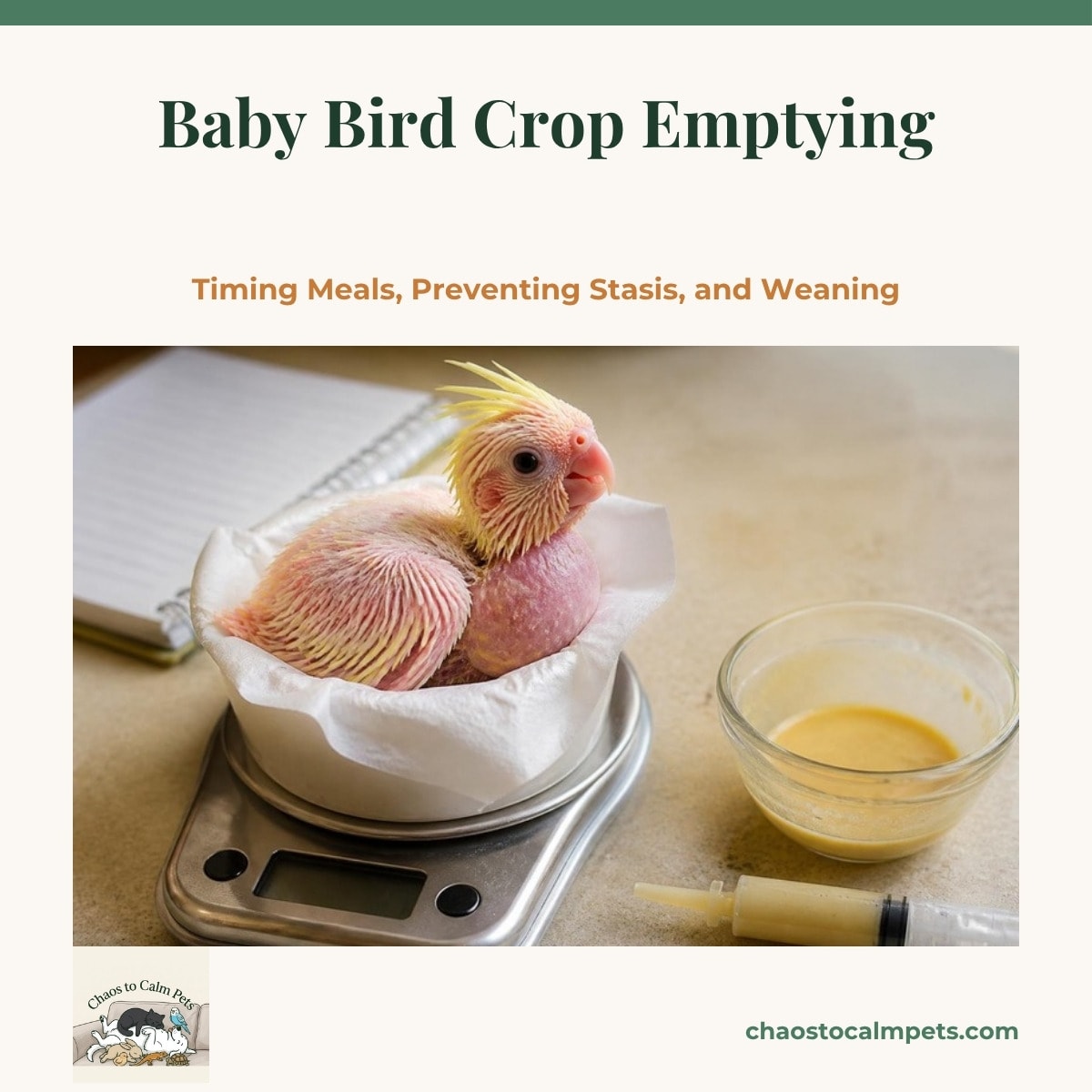
Baby Bird Crop Emptying
Timing Meals, Preventing Stasis, and Weaning
A crop that doesn't empty is the first sign most hand-feeders miss. 10 lessons on what the crop is and why it can't digest anything on its own, the 10 percent rule for meal size, feeding every 2, 4 or 6 hours by age, why the crop must go flat once a day, watching formula move down into the stomach, what to do when the crop is still full at feeding time, how overfeeding stretches it into a pendulous pouch, thinning formula to get a sluggish crop moving, why topping off old formula makes it rot, and shifting the emptying cycle as the bird weans.
About this course
If you hand-feed, the crop is the gauge you check before every meal. You'll start with what the crop is: an elastic storage pouch at the base of the neck that holds food and releases it slowly into the stomach, with no enzymes of its own, which is why anything that sits there too long rots. Then the two rules that prevent most trouble: a single meal is about 10 percent of body weight in grams, measured in milliliters, so a 50-gram chick gets 5 milliliters, and feeding intervals stretch from every 2 hours in week one to every 6 hours by weaning. You'll learn why the crop must go flat at least once a day, usually overnight, and how to watch it deflate from a tight ball to a soft fold against the breastbone and log the time it takes. The middle lessons are the problems: a crop still full at the next feeding and the checklist of brooder warmth, formula temperature, hydration and infection that goes with it, the pendulous crop that overfeeding creates, thinning formula with warm electrolytes to get things moving, and the top-off mistake that turns a crop into a fermentation tank. You'll finish with weaning, when solid food clears more slowly and liquid feeds step down from three to two to one.
What you'll learn
- What the crop is and why food rots in it, and the 10 percent meal rule
- Feeding every 2 hours in week one, stretching to every 6 hours by weaning
- Why the crop must empty once a day, and watching it deflate to a soft fold
- What to check when a crop is still full at feeding time, and the never-top-off rule
- How overfeeding creates a pendulous crop, and thinning formula to move a sluggish one
- Why topping off ferments into rot, when to call the vet, and weaning step-downs
Who this is for
First-time hand-feeders holding a syringe and a chick and not sure how much is too much, keepers who found a crop full in the morning and want to know what it means, and anyone whose vet mentioned slow crop or sour crop and wants to prevent it next time.
Course outline (10 modules)
Quiz & Certificate
Knowledge quiz
After completing all lessons, take a short quiz to test your understanding.
Go to quiz →Completion certificate
Pass the quiz and earn a shareable certificate of completion.
View certificate →Frequently asked questions
Ready to get started?
$9.99 · Lifetime access · 10 lessons