
Health & Care · Cold-Blooded Crew
The Arboreal Canopy
Advanced Husbandry for Tree-Dwelling Geckos, Chameleons, and Anoles
For a tree-dweller, the floor is lava. 20 modules on the three-dimensional world, screen cages for chameleons versus hybrid glass for tropical geckos, 36 to 48 inches of height, the vertical thermal stack, mesh that eats 30 to 40 percent of your UVB, misting systems and slow drippers, pesticide-free weeping figs and pothos, zip-tied branch matrices, drainage layers and bare-bottom trays, gut-loading and the eyes-apart sizing rule, bowl-free tong feeding and hanging ledges, zygodactyl feet and turret eyes, toe pads and tail drops, sauna boxes for dehydration, the calcium-D3-multivitamin rotation, canopy rearrangement, defensive posturing, the daily four-point scan, and the ARAV directory.
About this course
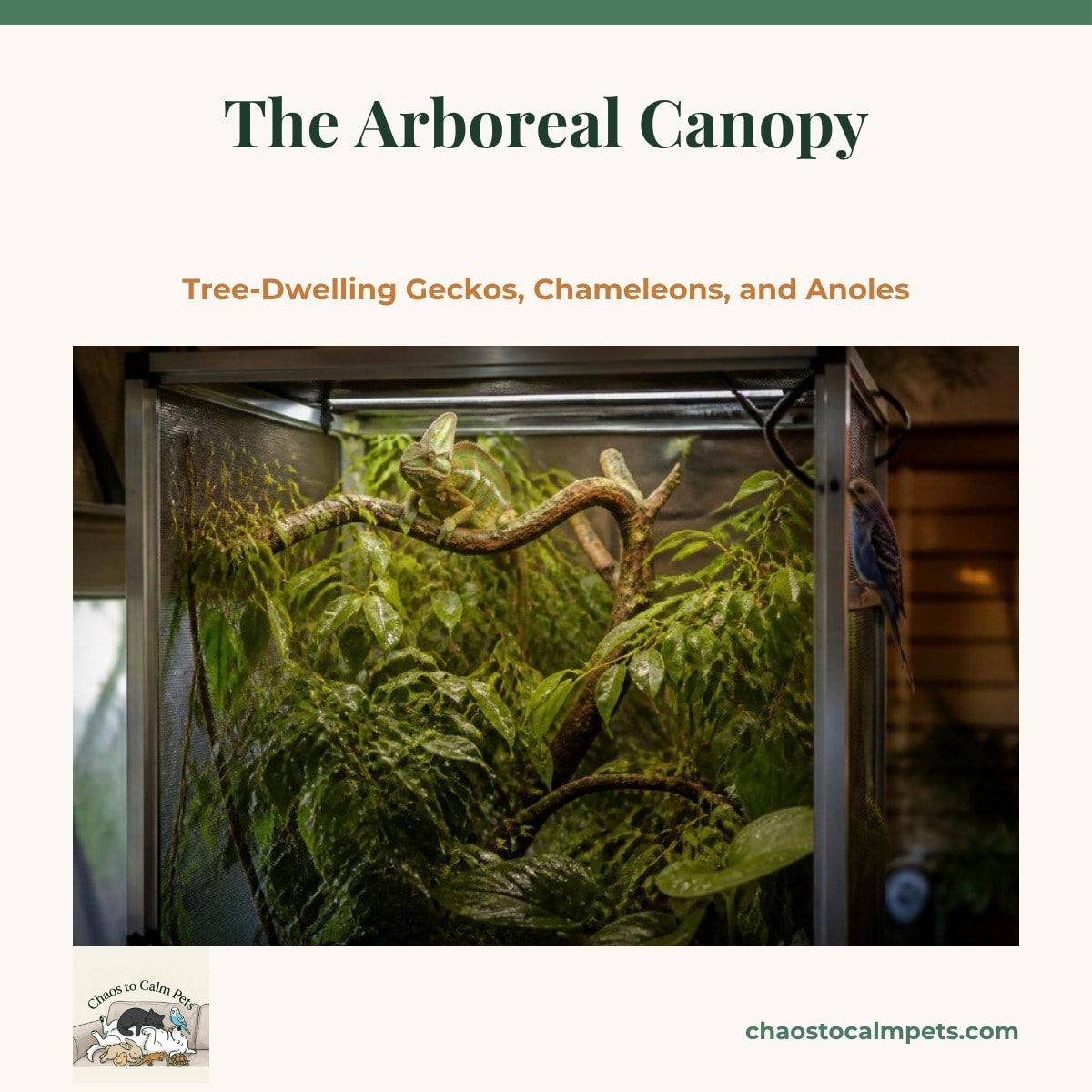
A chameleon or a crested gecko lives its whole life above the ground, and a horizontal tank built for a leopard gecko slowly fails it. This course builds upward. You'll learn why the canopy is a microclimate of moving air, dappled light, and a temperature gradient from top to bottom, why chameleons need full aluminum screen and tropical geckos need hybrid front-opening glass, why adults need 36 to 48 inches of height filled with branches so there's no dead space, how to mount heat at the top and read the vertical thermal stack with thermometers on several tiers, why screen mesh blocks 30 to 40 percent of UVB and how a T5 HO fixture with a reflector compensates, why these animals drink moving droplets off leaves and how misting systems and slow drippers deliver them, which live plants are sturdy and how to wash, wipe, and quarantine them for 30 days against pesticides, how to sanitize and rigidly anchor oak, manzanita, and bamboo into a grid of perches, pillars, and bridges, how a clay drainage layer and springtails keep the bottom from turning into a swamp, why feeders are gut-loaded 24 hours ahead and never wider than the space between the eyes, why the food bowl goes and tongs and hanging ledges replace it, what fused zygodactyl feet, turret eyes, and a ballistic tongue mean for cage design, how to protect gecko toe pads and prevent tail drops, how to read sunken eyes and orange urates and run a sauna box, how the calcium, D3, and multivitamin rotation plus UVB prevents metabolic bone disease, why rearranging branches keeps a canopy mind busy, what hissing, darkening, and gaping mean and why forced handling wrecks immunity, how to run the daily four-point scan and a paper-towel quarantine bin, and how to find a herp vet through the ARAV directory.
What you'll learn
- The three-dimensional world, canopy microclimates, and screen versus hybrid glass
- Enclosure height, dead-space elimination, the vertical thermal stack, and UVB through mesh
- Misting and drippers, safe pesticide-free plants, and anchored branch matrices
- Drainage and substrate, gut-loading, dusting rotations, sizing, and bowl-free tong feeding
- Chameleon feet, eyes, and tongue, gecko toe pads and tail drops, and dehydration triage
- Metabolic bone disease prevention, enrichment, defensive thresholds, daily scans, and herp vets
Who this is for
Keepers of veiled and panther chameleons, crested and gargoyle geckos, day geckos, and green anoles, anyone upgrading from a starter tank, and anyone whose chameleon has sunken eyes or won't drink from a bowl.
Course outline (20 modules)
Quiz & Certificate
Knowledge quiz
After completing all lessons, take a short quiz to test your understanding.
Go to quiz →Completion certificate
Pass the quiz and earn a shareable certificate of completion.
View certificate →Frequently asked questions
Ready to get started?
$9.99 · Lifetime access · 20 lessons