
Household & Multi-Pet · Aquatic
African Cichlids
The Rock-Dwelling Aggressors of the Rift Lakes
Rift Lake cichlids bring reef-tank color to fresh water, along with hard-water needs and big tempers. 10 lessons on Rift Lake water chemistry, mbuna rock dwellers, peacocks and haps, controlled overcrowding, building a rock wall that won't crack the glass, the herbivore diet that lowers the risk of Malawi bloat, frontosas, shell dwellers, how mouthbrooding works, and buffering with crushed coral and aragonite.
About this course
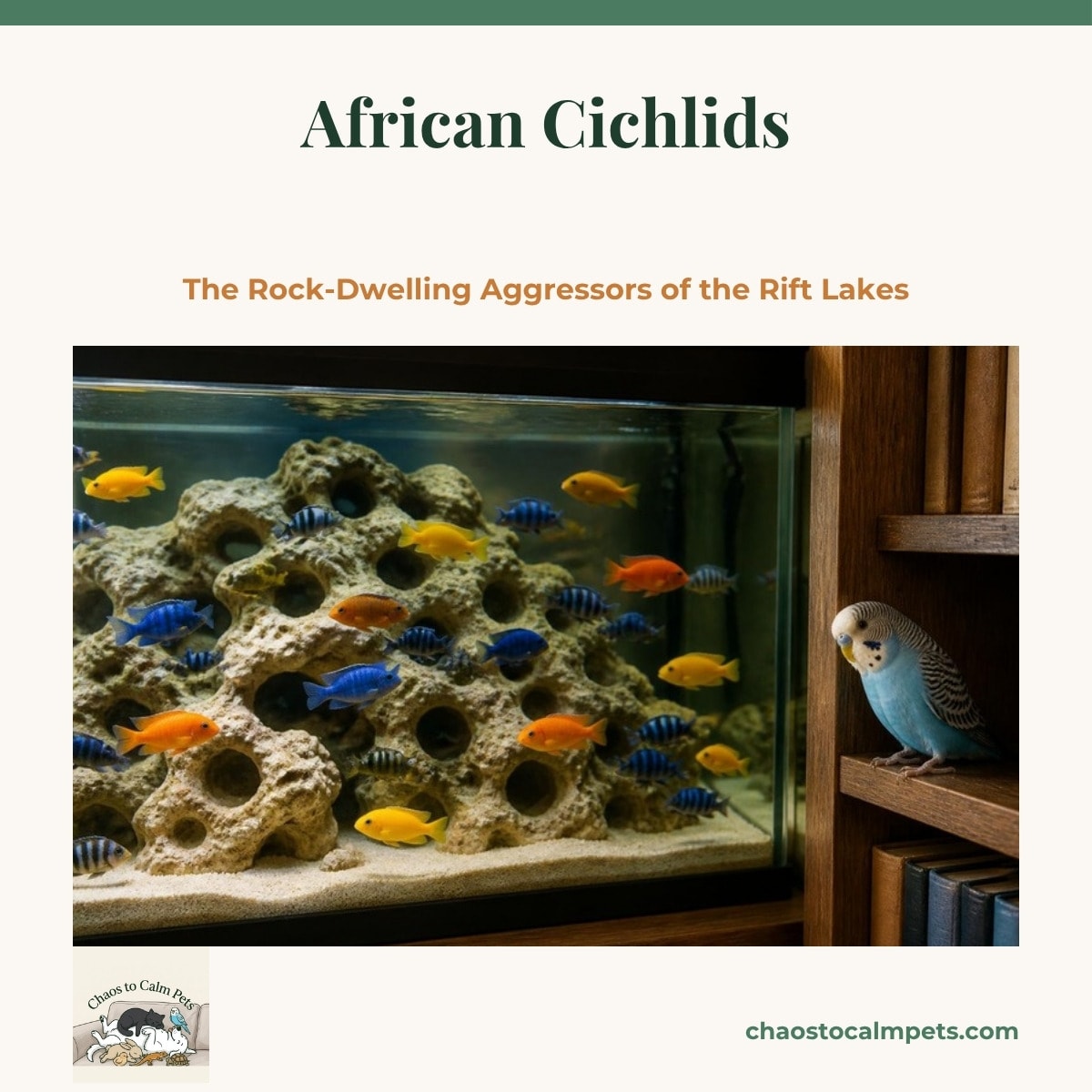
African cichlids from Lake Malawi and Lake Tanganyika live in hard, alkaline water and fight hard over rock caves, so keeping them well starts with chemistry and planning. Lesson 1 covers the water: a steady pH of about 7.8 to 8.6 for Malawi fish and 8.5 to 9.0 for Tanganyikans, with good general and carbonate hardness. Then you'll meet the mbuna, rock-dwelling grazers that defend their caves with real force, and the calmer peacocks and larger haps, which do better together than with mbuna. Lesson 4 explains controlled overcrowding: why a small group of mbuna often ends with one fish being hunted, and why a fuller tank with heavy filtration and big water changes spreads aggression out. Lesson 5 is the rock wall, with eggcrate on the glass, foundation rocks placed before sand, and epoxy on arches. Lesson 6 covers the high-fiber diet that lowers the risk of Malawi bloat and the signs to watch for. The last four lessons cover frontosas and their dim light, shell dwellers and their snail-shell colonies, how mouthbrooding females carry eggs and fry for 3 to 4 weeks, and how crushed coral or aragonite helps keep pH from falling.
What you'll learn
- Rift Lake water chemistry: steady pH, general hardness and carbonate hardness for each lake
- Mbuna rock dwellers, and why peacocks and haps do better apart from them
- Controlled overcrowding, sex ratios, and the filtration and water changes it demands
- Building a safe rock wall with eggcrate, foundation rocks and aquarium epoxy
- The high-fiber mbuna diet, signs of Malawi bloat, and calm, dim-light frontosas
- Shell dweller colonies, how mouthbrooding works, and buffering with crushed coral or aragonite
Who this is for
Keepers drawn to the color of mbuna and peacocks who want to start right; anyone whose cichlid tank has one fish being chased to exhaustion; and hobbyists planning a frontosa group or a shell dweller colony.
Course outline (10 modules)
Quiz & Certificate
Knowledge quiz
After completing all lessons, take a short quiz to test your understanding.
Go to quiz →Completion certificate
Pass the quiz and earn a shareable certificate of completion.
View certificate →Frequently asked questions
Ready to get started?
$9.99 · Lifetime access · 10 lessons